Hard Water Stains: A Spring, TX Home Cleaning Guide
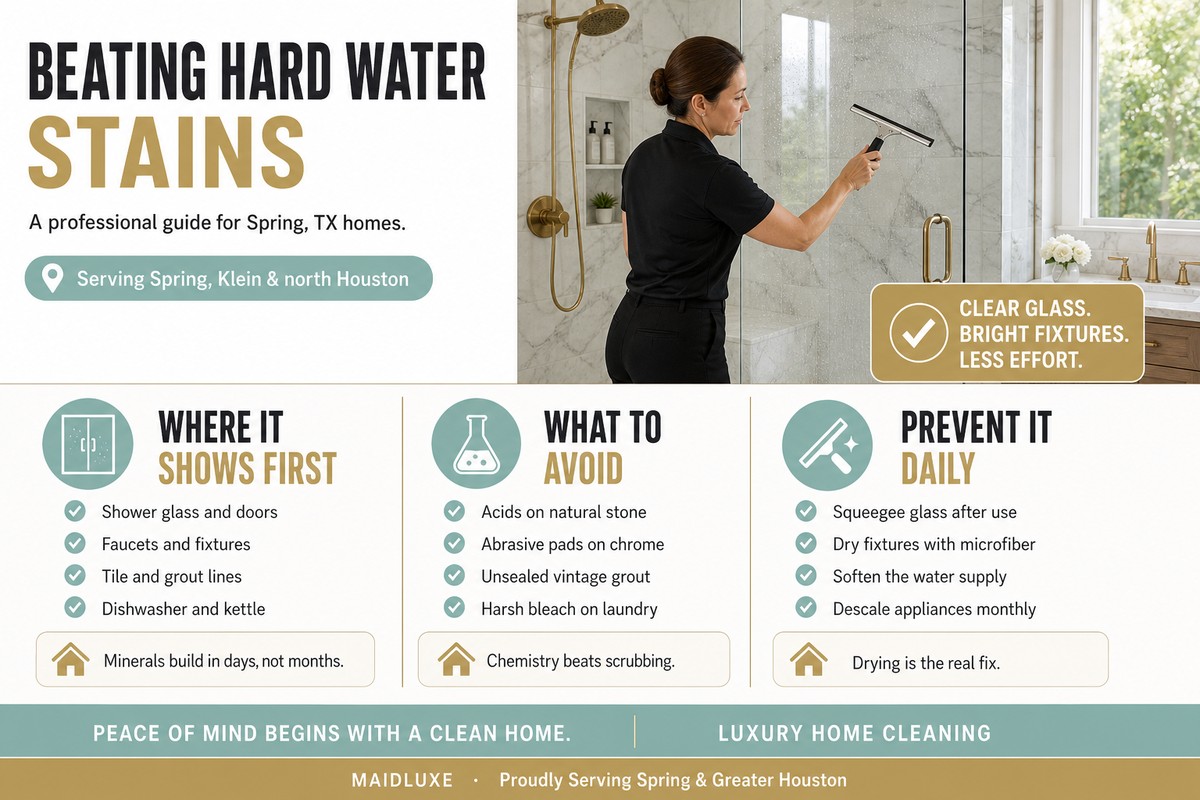
- Know what you're removing: alkaline cleaners for soap and oil, mild acids for mineral scale; sequence cleaners for full removal.
- Use dwell time not scrubbing: let descalers sit 5 to 15 minutes, then agitate with a non-scratch pad to avoid damage.
- Prevent deposits: squeegee after showers, dry fixtures, ventilate, consider a water softener, and apply glass sealant periodically.
- Protect vulnerable materials: never use acidic descalers on marble, limestone, unsealed grout, specialty metal finishes, hardwood, or vinyl; never mix cleaners.
If you live in Spring, Texas, you have probably had this experience: you clean the glass shower door on Saturday, and by Wednesday it looks cloudy again. Or you polish the kitchen faucet and a chalky white ring reappears at the base within days. That is not a cleaning problem. That is hard water, and across north Harris and south Montgomery County it is one of the most persistent challenges homeowners face.
Our MaidLuxe technicians work in homes throughout Spring, Klein, Gleannloch Farms, and the neighborhoods off Louetta and Kuykendahl, and hard-water mineral buildup comes up in nearly every consultation. The good news is that it is manageable — but only if you understand what you are actually removing and what surfaces will not tolerate the products that remove it.
Why Hard Water Is Such a Problem for Spring, TX Homes
“Hard” water simply means water carrying dissolved minerals, primarily calcium and magnesium. Greater Houston’s supply draws heavily on surface water treated and distributed regionally, and the water reaching homes across the Spring area is commonly measured in the moderately-hard to hard range. Every time that water evaporates on a surface, the water leaves and the minerals stay behind. Repeat that a few hundred times and you get the film, spotting, and crust that homeowners describe as “soap scum.”
That distinction matters, because most of what people call soap scum is actually two different things layered together:
- Mineral scale (limescale): calcium and magnesium carbonate deposits. Alkaline in nature, so it dissolves with mild acids.
- Soap and body-oil residue: fatty, greasy film. This responds to alkaline degreasers and surfactants, not acids.
Using only one type of product on a shower that has both is why homeowners scrub for an hour and get halfway results. Professionals sequence them: alkaline cleaner first to break down the oily film, rinse, then a mild acidic descaler with dwell time to dissolve what remains.
Dwell Time Beats Scrubbing Power
The single biggest technique change we recommend to Spring homeowners is patience instead of force. Mineral scale dissolves through chemical reaction, and that reaction needs contact time — typically 5 to 15 minutes on a wet surface. Spraying and immediately wiping accomplishes very little; spraying, letting it dwell, then agitating with a non-scratch pad accomplishes a great deal. Aggressive scouring, by contrast, is how glass, chrome, and stone get permanently marred.
Where Hard Water Shows Up First
Glass shower enclosures
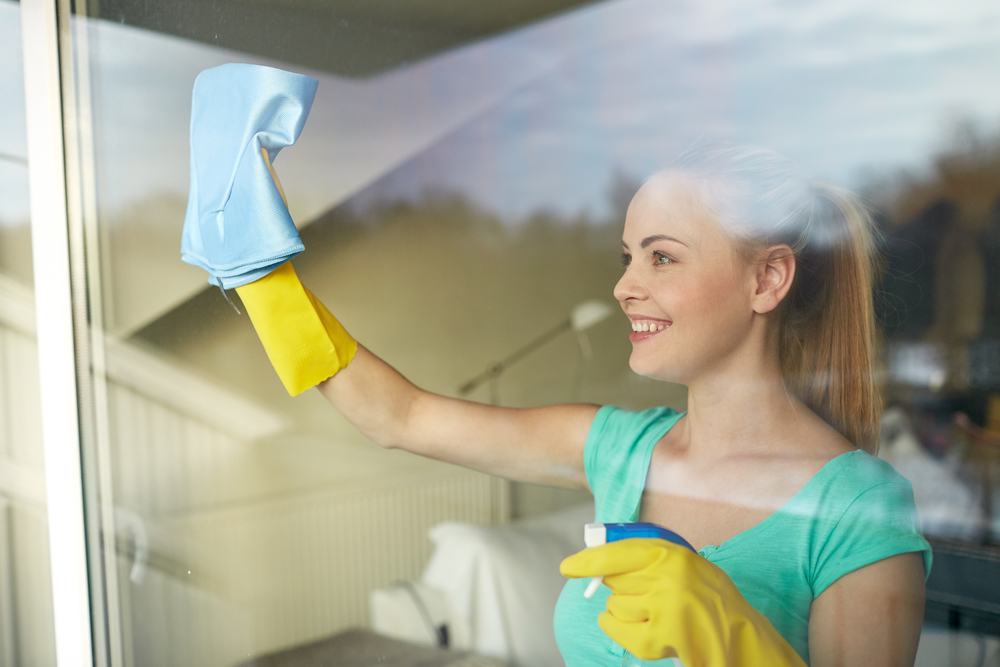
Frameless glass is the most common casualty in newer Spring homes. Untreated glass is microscopically porous, and minerals lodge in it. Early buildup wipes away with a mild acidic cleaner and dwell time. Long-neglected buildup, however, can etch the glass permanently — at which point no product on the market restores clarity, and replacement or professional polishing is the only remedy. Prevention is enormously cheaper: keep a squeegee in the shower and use it for ten seconds after each use. This is the highest-return habit in a hard-water home.
Fixtures and faucets
Chrome and polished nickel tolerate a mild acidic descaler well. Do not use one on unlacquered brass, oil-rubbed bronze, matte black, or living finishes — those coatings and patinas can be stripped or blotched, sometimes on first contact. For those, warm water, a mild neutral cleaner, and a soft cloth, plus drying immediately, is the correct approach. Aerators are worth unscrewing quarterly and soaking; a clogged aerator, not low pressure, is behind most weak faucet complaints.
Sinks, tubs, and toilets
Porcelain and enameled surfaces handle descalers well. The toilet ring at the waterline is mineral, not stain — a pumice stone made for porcelain removes it safely, while abrasive powders and stiff brushes leave micro-scratches that then collect more deposit.
Dishwashers, washing machines, and water heaters
Scale accumulates inside appliances just as visibly as on glass, and it reduces both efficiency and lifespan. Cloudy glassware coming out of the dishwasher is a hard-water signal, not a detergent failure; a rinse aid plus a monthly descaling cycle usually resolves it. Water heaters in hard-water areas benefit from an annual flush, which is genuinely one of the better returns on a small maintenance investment.
What Hard Water Products Must Never Touch
This is the part where well-intentioned DIY causes permanent damage, and it is worth being direct about it. Do not use vinegar, lemon, or any acidic lime remover on:
- Marble, travertine, limestone, or onyx — these are calcium-based, so an acid that dissolves limescale also dissolves the stone, leaving dull etch marks that cannot be wiped away
- Natural stone tile or slab showers — the same chemistry applies, and shower walls show etching dramatically
- Unsealed grout — repeated acid exposure erodes the cement matrix over time
- Hardwood or luxury vinyl flooring — acid plus standing water damages finishes and seams
- Specialty metal finishes — as noted above, coatings do not survive it
A related safety point worth repeating: never mix cleaning products. Combining bleach with an acidic cleaner releases chlorine gas, and combining bleach with ammonia releases chloramine vapors. The CDC’s guidance on cleaning chemical safety is unambiguous on this, and it is one of the training points our technicians revisit every year. Use one product, rinse thoroughly, then use the next.
Prevention: The Part That Actually Saves Money
Removing scale is remedial work. Preventing it is where Spring homeowners see the real difference.
- Dry wet surfaces. Minerals only deposit when water evaporates in place. A squeegee in the shower and a dry cloth on the faucet after use eliminates most buildup before it starts.
- Ventilate. Run the bath exhaust fan for 20 minutes after showers. This reduces both mineral deposition and the mildew that Houston-area humidity encourages in grout.
- Consider treatment. A whole-home water softener or conditioner meaningfully reduces scale on fixtures, glass, appliances, and even laundry. It is an investment, but in this part of the metro it is a defensible one, especially in homes with extensive glass and stone.
- Apply a glass sealant. Hydrophobic treatments on shower glass make water sheet off rather than bead and evaporate. They wear out and need reapplication a few times a year, but they work.
- Stay on a rhythm. Light mineral film removed weekly never becomes the bonded crust that requires harsh intervention.
The Overlooked Casualty: Your Laundry
Hard water quietly undermines laundry results, and most homeowners blame the detergent. Calcium and magnesium ions bind with detergent surfactants before they can lift soil, which means a portion of every scoop is neutralized on contact. The practical symptoms are familiar across Spring homes: towels that feel stiff and stop absorbing, dark fabrics that develop a gray cast, whites that turn dingy, and a faint sour smell in gym clothes that survives washing.
What actually helps:
- Use less detergent, not more. Overdosing leaves residue that traps minerals in the fibers. Follow the low end of the label and adjust from there.
- Add a water conditioner or washing soda to the wash, which binds minerals so detergent can do its job.
- Skip fabric softener on towels. It coats fibers and compounds the stiffness hard water already causes. A half cup of white vinegar in the rinse works better and rinses clean.
- Run a monthly empty hot cycle with a machine cleaner to clear scale and biofilm from the drum and gasket.
Because laundry in a hard-water home takes real technique, it is one of the add-ons our clients request most often — wash, dry, fold, and put away, handled the same way every week so linens stay soft rather than slowly degrading. Learn more about our laundry services if that is a chore you would rather hand off.
Neighborhood Realities Around Spring
A few local patterns are worth naming. Homes in the newer master-planned sections around Gleannloch Farms and Augusta Pines tend to have expansive frameless glass and large-format tile — beautiful, and the fastest surfaces to show mineral spotting, which is why a squeegee habit matters most here. Older properties closer to Old Town Spring and along the Spring Creek corridor more often have aging fixtures and unsealed grout where scale has had years to bond, and those benefit from a staged restoration before routine maintenance can hold. And across all of Spring, the heavy pine canopy means fine organic debris tracks indoors year-round, which mixes with mineral film on entry tile into a haze that neither a plain mop nor a plain descaler fully removes on its own.
When to Handle It Yourself, and When to Call a Professional
Honestly, routine hard-water maintenance is well within a homeowner’s reach. Weekly bathroom wipe-downs with the right products, a squeegee habit, and a monthly descaling pass on fixtures will keep most Spring homes ahead of the problem, and we would rather clients know that than be sold something they do not need.
Professional help earns its place when:
- Buildup has been accumulating for years and needs a controlled, staged restoration rather than a weekend of guessing
- Your home has natural stone, specialty metals, or high-end glass where a single wrong product causes permanent damage
- You are preparing a home for sale or handing one over after a move, where showers and fixtures are inspected closely
- You simply want the maintenance rhythm handled consistently by the same trained technician, so buildup never gets a foothold
That consistency is the heart of our model. A dedicated technician who knows your shower glass is sealed, your primary bath is marble, and your kitchen fixture is living brass will treat each correctly every visit — which is precisely how hard-water damage is avoided rather than repaired.
Clear Glass, Bright Fixtures, Less Effort
Hard water in Spring, Texas is not going away, but its visible effects are entirely controllable with correct chemistry, adequate dwell time, restraint around vulnerable materials, and habits that stop deposits before they form.
If you would like that handled for you, learn more about house cleaning in Spring, TX, compare our Luxe Cleaning restorative deep clean with recurring Essential Cleaning, or take a look at our add-on services for appliance interiors and interior windows. When you are ready, request a quote — peace of mind begins with a clean home.
Share this article
Related Posts






Follow us
A quick overview of the topics covered in this article.