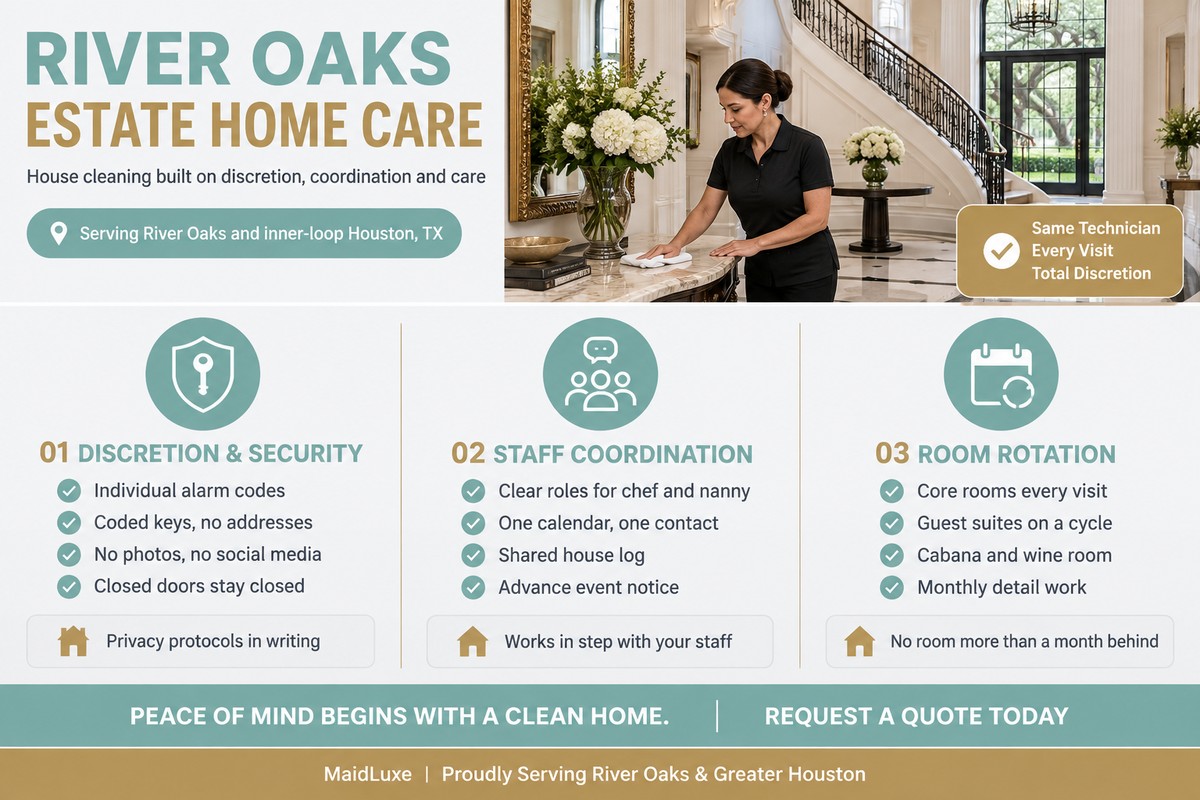


The Woodlands House Cleaning: Chandeliers & High Ceilings
- High fixtures collect sticky pine pollen, humid Gulf Coast film, and HVAC-driven dust, dimming light and bonding soils twenty feet overhead.
- Professionals use fixture-specific methods: distilled water plus isopropyl for crystal, dry vacuum for alabaster and capiz, microfiber for patinas, pillowcase for fan blades.
- Safety non-negotiables: power off at the breaker, bulbs cooled, drop cloths, proper platform with spotter, and stop if the canopy rocks; call an electrician.
- Schedule: in-place cleans twice yearly after pollen and before holidays; takedown only for heavy film, insect debris, antiques, or fixtures over 50 pounds.
The homes in The Woodlands were designed to look up. Two-story foyers, vaulted great rooms in Carlton Woods and Alden Bridge, stairwell landings crowned with a chandelier, clerestory windows framing the pines. It is one of the most beautiful housing stocks in the Houston metro — and it creates a cleaning problem almost no homeowner solves on their own, because the dirtiest surfaces in the house are twenty feet overhead.
If you have been looking for house cleaning services in The Woodlands and quietly wondering who is supposed to handle the chandelier over the entry, the fan blades above the stairs, or the dusty tops of that soaring window casing, this guide answers it: what actually accumulates up there, how professionals clean each fixture type without damaging it, when a chandelier genuinely needs a full takedown, and when a careful in-place clean is enough.
Why High Fixtures Get Filthy Faster in The Woodlands
Airborne soil rises with warm air and settles on the first horizontal surface it meets. In a volume-ceiling home, that surface is a light fixture. Three local factors accelerate it.
- The tree canopy. The Woodlands is built inside a working pine forest. Loblolly pine pollen in late winter and spring, then fine needle debris and oak catkins, ride indoors every time a door opens. Pine pollen is sticky enough to bond to metal and glass rather than brush off.
- Humidity. Gulf Coast air keeps interior dust slightly damp, so it adheres to crystal, glass shades and fan blades in a film rather than sitting loose. That film is why a duster on a pole appears to work and changes nothing.
- Constant HVAC operation. From April through October the system runs nearly nonstop, driving a continuous convection loop that carries kitchen aerosols and skin-cell dust up into the ceiling volume. Homes with an open kitchen adjacent to a two-story family room — the standard Woodlands floor plan — see the heaviest deposits.
The result is layered: dust bonded in a faintly greasy film, plus insect debris inside enclosed shades, plus oxidation on brass and bronze arms. It looks like dimming. Homeowners routinely replace bulbs when the real issue is that the fixture has lost thirty to forty percent of its light output to grime.
What Professionals Actually Do, Fixture by Fixture
Crystal chandeliers
Real leaded crystal and modern optical crystal are cleaned with a solution of distilled water and a small amount of isopropyl alcohol, applied to a lint-free cloth rather than sprayed. Two reasons: spraying drives moisture into the socket housing, which is a genuine electrical hazard, and Houston tap water is hard enough to leave calcium spotting on every drop as it dries. Distilled water is not fussiness — it is the difference between clear crystal and a chalky veil.
Each drop is supported while wiped so the pin or hook is not stressed. Ammonia-based glass cleaner is avoided entirely on antique or gold-plated frames, because it attacks the plating and can cloud older leaded crystal.
Alabaster, capiz shell, and paper or linen drum shades
These are dry-clean only. Alabaster is porous gypsum stone and will absorb a water mark permanently. Capiz shell delaminates when wet. Linen and paper shades stain and warp. All of them get soft-brush and low-suction vacuum work with a screen over the nozzle — never a damp cloth.
Wrought iron, bronze and matte black
Very common in The Woodlands’ Hill Country and transitional interiors. These are almost always factory-finished with a clear coat or a hand-applied patina, so they are cleaned with a barely damp microfiber and dried at once. Any acidic descaler or all-purpose degreaser strips the finish and leaves permanent light patches — the most frequent avoidable damage we see on high fixtures.
Ceiling fans over stairwells and great rooms
Blades are cleaned with a pillowcase slipped over each blade and drawn back, capturing the dust rather than dropping it two stories onto furniture and rugs. The blade’s leading edge and the motor housing top hold the most; the housing is dry-wiped only.
Enclosed glass shades and recessed trims
Enclosed shades collect insect debris and require removal, washing and — critically — complete drying before reinstallation. Recessed can trims collect a gray ring of airborne soil that is invisible from below but obvious from a ladder.
Safety First: The Part Homeowners Underestimate
We are candid with clients about this because falls are not hypothetical. The Centers for Disease Control and Prevention identifies falls as a leading cause of injury among adults, and a stairwell landing is the single worst place in a house to balance a ladder — the base sits on a tread, the reach is over a railing, and there is a drop on one side.
Non-negotiables before any high fixture is touched:
- Power off at the breaker, not merely the wall switch. Switches can be wired to interrupt the neutral, leaving the fixture live.
- Bulbs cool completely. A halogen or older incandescent bulb will crack if a cool cloth touches it hot. Never touch a halogen capsule with bare fingers; skin oil creates a hot spot that fails the bulb.
- Drop cloths below, covering the floor and any furniture. Twenty feet of falling grit is a second cleaning job.
- Proper platform, never a chair or the stair treads. Volume ceilings need scaffolding or a stabilized extension ladder with a spotter.
- Check the canopy and mounting. If a fixture rocks or the canopy has separated from the ceiling, stop and call an electrician. Cleaning is not the fix.
Any fixture over about fifty pounds, on a motorized winch, or wired into a plaster medallion should be serviced by a specialist rather than cleaned in place.
Chandelier Takedown or In-Place Clean?
A full takedown — removing every crystal, washing, drying and re-hanging to a photographed map — is a multi-hour job and is not needed annually.
An in-place clean is sufficient when the fixture has been maintained within the last year, the crystals are dusty rather than filmy, and it hangs outside the kitchen’s airflow. In The Woodlands, a good cadence is a light in-place clean two to three times a year, timed just after pine pollen season ends in spring and again before holiday hosting in November.
A full takedown is warranted when the fixture has not been cleaned in several years, there is visible greasy film from a nearby kitchen, drops look cloudy or gray rather than dusty, there is insect debris inside enclosed elements, or you can see a measurable difference in light output. Antique and heirloom fixtures should be mapped photographically before disassembly — crystal arrangements are rarely symmetrical, and reassembly from memory almost never matches.
What You Can Reasonably Do Yourself
Honest answer: single-story fixtures, standard ceiling fans reachable from a stable step ladder, and light dusting of accessible chandeliers with a proper lambswool duster. That is real, useful maintenance, and doing it quarterly meaningfully slows buildup.
What we would not recommend doing yourself: anything over a stairwell, anything above roughly twelve feet, alabaster or capiz shades, gold-plated or antique frames, and any fixture you cannot reach without standing on something that was not built to be stood on.
Fitting High-Fixture Care Into a Cleaning Schedule
High fixtures are detail work, not maintenance work, which is why they belong in a periodic deep visit rather than a weekly one. Our Luxe Cleaning service is where fixture and high-surface detail lives — light fixtures, fan blades, high window casings, upper cabinet tops and vents. Between those resets, Essential Cleaning keeps the rest of the home in rhythm on a weekly or biweekly schedule, and homeowners who want fixture work handled at a set interval can arrange it through our add-on services alongside interior windows.
The practical Woodlands calendar most of our clients settle into: recurring maintenance year-round, a Luxe reset with full fixture detail in late spring once pollen season closes, and a second fixture pass in November before entertaining season. Households selling a home benefit from fixture detail too — buyer photographs of a two-story foyer are unforgiving, and a clean chandelier changes the light in the entire frame. If you are moving within the community, our Move In / Move Out Cleaning covers fixtures in an empty home, which is by far the easiest time to do it.
Because MaidLuxe assigns a dedicated technician to your home rather than rotating crews, she knows which fixtures in your house need distilled water, which shades must stay dry, and which fan over the stairs collects the most — the kind of detail that only continuity produces. You can see our full local service outline on our house cleaning in The Woodlands page.
Look Up Before the Holidays
Stand in your entry this week and look straight up. If the chandelier reads gray rather than bright, if the fan blades above the stairs have a visible edge of fur, if the tops of the window casings have gone soft-focus, your home is losing light and air quality to surfaces nobody has touched in a year — and September, before pollen returns and before hosting season, is the ideal window to fix it.
To have your fixtures, high surfaces and the rest of your home detailed by a team that works in volume-ceiling homes across The Woodlands every week, request a quote or get in touch through our contact page. We will tell you honestly whether your chandelier needs a takedown or simply a careful in-place clean.
Share this article
Related Posts







Follow us
A quick overview of the topics covered in this article.