Licensed and Bonded House Cleaning: What It Means in Texas
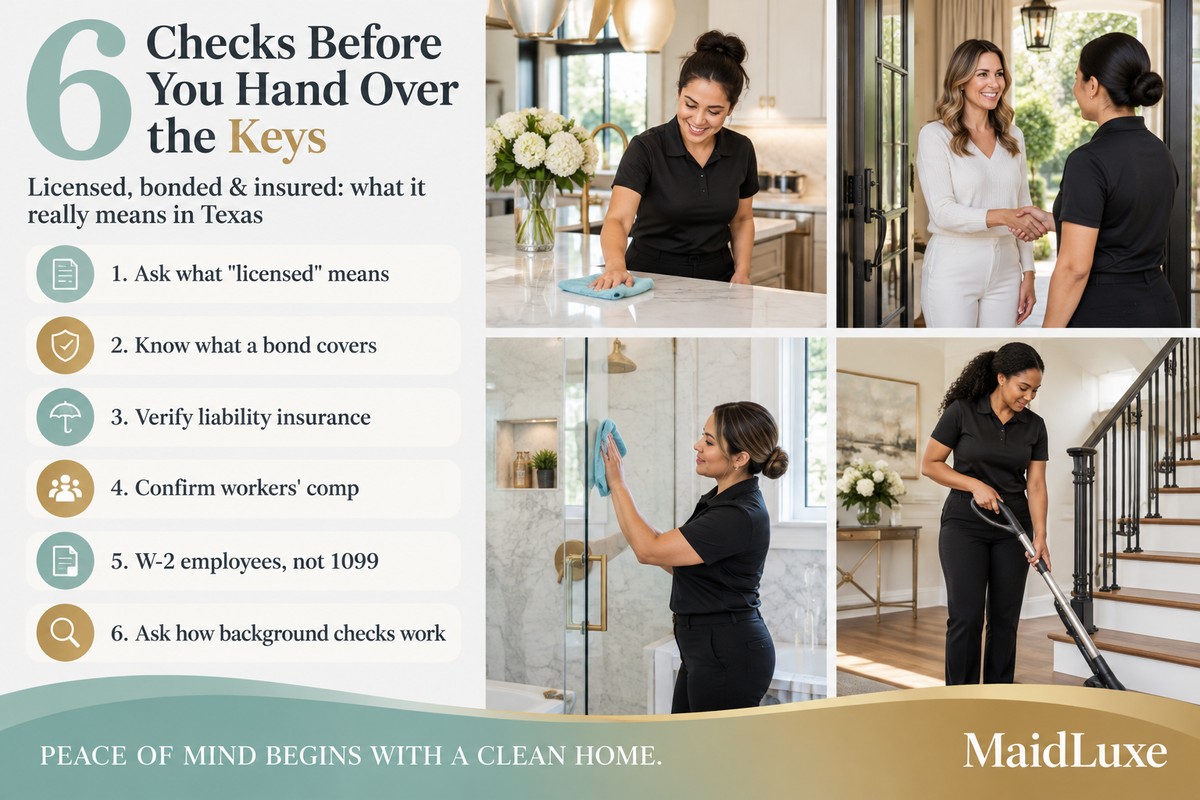
- Texas does not license residential house cleaners; ask what "licensed" means and confirm business registration and sales tax permit.
- Bonded usually covers employee theft only, often requires conviction, and carries claim limits; it does not replace liability insurance.
- Get a certificate of insurance from the agent, verify policy limits and dates, and confirm workers compensation coverage with Texas DOI.
- Confirm whether cleaners are W-2 employees or 1099 contractors; this affects bonding, insurance coverage, training, and background checks.
- Ask specific background check, key handling, and satisfaction policy questions; consistency and a dedicated technician improve safety and accountability.
Almost every cleaning company in the Houston area promises to be “licensed, bonded and insured.” The phrase shows up on yard signs in Spring, on Nextdoor posts in The Woodlands, and on nearly every website you will compare. The trouble is that most homeowners never find out what those three words actually cover, until something breaks, goes missing, or someone gets hurt in their home.
This guide explains what licensed and bonded house cleaning really means in Texas, which protections matter most when someone has a key to your home, and how to check a company’s claims in about ten minutes. It is written for homeowners in The Woodlands, Spring and the rest of north Houston, but the Texas rules apply across the metro.
What “Licensed” Means for House Cleaning in Texas
Here is the part most companies leave out: Texas does not issue a license for residential house cleaning. The Office of the Governor’s business permit guidance states that a small-scale residential or commercial cleaning business does not require a special permit or license from the state. There is no state exam, no license number and no board that disciplines maids.
Local licensing rarely fills that gap, especially north of Houston. The Woodlands is not an incorporated city. It is a planned community governed by The Woodlands Township, a special-purpose district, and Spring is unincorporated as well. There is no city hall in either community issuing a general business license to cleaning companies. So when a cleaner in The Woodlands says they are “licensed,” it is fair to ask, politely, “Licensed by whom?”
What to look for instead of a license
- A registered business. An LLC or corporation is on file with the Texas Secretary of State, and you can confirm it is active through the Texas Comptroller’s free taxable entity search.
- A sales tax permit. The Texas Comptroller treats maid and janitorial services as taxable, so an established cleaning company should be collecting sales tax and holding a permit.
- A physical presence and a track record. A local office, a business phone that someone answers, and years of reviews tell you far more than the word “licensed.”
None of these is a quality guarantee. They simply show that you are dealing with a real, accountable business rather than a phone number and a first name.
What a Bond Covers (and What It Doesn’t)
“Bonded” usually refers to a janitorial service bond, a type of surety bond that reimburses clients when an employee of the cleaning company steals from them. It is a real protection, but a narrower one than most people assume:
- It is about theft, not accidents. A bond generally does not pay for a chipped marble vanity or a scratched hardwood floor. That is what liability insurance is for.
- It often requires a conviction. Many janitorial bonds only pay after the employee has been convicted of the theft, which can take months.
- It has a ceiling. Bonds carry a set limit per claim. If the bond is small and your losses are large, the difference falls back on the company, or on you.
- It does not cover independent contractors. A bond covers the company’s own employees. If a business sends 1099 contractors, ask directly whether the bond applies to them.
Think of a bond as a sign that the company takes theft seriously enough to pay for coverage. The real protection is the hiring process that keeps the wrong person out of your home in the first place.
Insurance That Actually Protects Your Home
In practice, two policies do most of the protecting: general liability insurance and workers’ compensation.
General liability
General liability covers accidental damage and injuries to third parties. In a luxury Houston home, that might mean a cleaning solution that etches a honed marble countertop, a ladder that dents a custom door, or an overflowing sink that damages a wood floor. Two details are worth asking about:
- The limit. A policy with a low limit may not go far in a home with designer finishes, art and imported stone.
- Coverage for client property. Some general liability policies limit coverage for property in the cleaner’s “care, custody or control,” which is exactly the situation when someone is dusting your collectibles. Ask whether the policy covers damage to client belongings while the team is working.
Workers’ compensation: the Texas difference
Texas is unusual: private employers can choose whether to carry workers’ compensation. Companies that opt out are called “non-subscribers.” In most states every cleaning company with employees carries it. In Texas, many do not.
That matters to you because cleaning is physical work. People climb step stools to reach transom windows, carry vacuums up stairways and kneel on hard tile. If a cleaner is hurt in your home and the company has no workers’ compensation, the question of who pays for that injury gets complicated, and your homeowner’s policy may be pulled into it. The Texas Department of Insurance offers a free workers’ compensation coverage verification tool so you can confirm coverage yourself.
Employees vs. Independent Contractors
Whether the people in your home are employees (W-2) or independent contractors (1099) shapes nearly everything above:
- Training and standards. A company can require employees to follow its methods, product rules and checklists. Contractors, by definition, largely set their own.
- Background checks and supervision. Employees go through the company’s hiring process and are accountable to a manager. With contractor arrangements, screening varies widely.
- Bond and insurance coverage. As noted above, a company’s bond and workers’ compensation may not extend to contractors at all.
- Your tax exposure. If you hire an individual directly and pay them above the IRS household employee threshold for the year, you may become a household employer with payroll tax obligations. A company that employs its own staff handles that for you.
Background Checks: Ask How, Not Just Whether
“Yes, we do background checks” is the expected answer. Better questions get more useful answers:
- Is it a criminal background check, and does it cover more than one county or state?
- Do you verify job history and references, or only run a database search?
- Do you drug-screen new hires?
- Is the check done before a new hire ever enters a client’s home?
- Will the same person clean my home each visit, or does it rotate?
Consistency is a security feature in its own right. In a gated village such as Carlton Woods, or any home with alarm codes and staff schedules, one known technician is far easier to manage than a rotating crew of strangers.
A 10-Minute Checklist for Woodlands and Spring Homeowners
Before you hand anyone a key, garage code or gate access, work through this list:
- Request a certificate of insurance (COI) sent directly from the company’s insurance agent, not a screenshot. Check the policy dates and limits.
- Ask whether workers’ compensation is in place, then confirm it with the Texas Department of Insurance lookup.
- Ask for the bond amount and whether it covers every person who will be in your home.
- Look up the business through the Texas Comptroller’s taxable entity search to confirm it is active.
- Ask about employment status: W-2 employees or 1099 contractors.
- Ask how background checks work: criminal, job history, drug screening.
- Ask about key and code handling: where keys are stored, how codes are recorded, and how gate access lists are kept up to date.
- Read the satisfaction policy: how quickly you need to report a problem and what happens next.
- Read recent reviews from homes like yours, looking for comments about honesty and consistency, not just sparkle.
If you want a broader list of questions about scheduling, pricing and products, our guide to the questions to ask before hiring a house cleaner covers the rest.
When an Independent Cleaner Is a Reasonable Choice
To be fair, plenty of independent cleaners do careful, honest work, and many homeowners have trusted the same person for years. If you go that route, a little structure protects you both. Talk to your homeowner’s insurance agent about how your policy treats a worker injured on your property, keep payment records, look into your household employer responsibilities, and don’t leave valuables, firearms or financial documents accessible. The risk isn’t the person. It is that no one stands behind the arrangement if something goes wrong.
How MaidLuxe Handles Licensed and Bonded House Cleaning
We built MaidLuxe around the protections described in this guide, because our clients trust us with their homes, families and routines:
- Every technician is a W-2 employee, never a subcontractor.
- Bonded, with full general liability and workers’ compensation coverage. We are happy to send a certificate of insurance.
- Criminal background checks, job history verification and drug screening on every prospective employee.
- A dedicated technician for recurring clients, who learns your home inside and out.
- A 100% satisfaction guarantee: let us know within 24 hours and we will return to re-clean.
Our Essentials Clean recurring maid service is where most clients start. Families north of the city can learn more about our house cleaning in The Woodlands and our house cleaning services in Spring, TX, and our FAQ page answers the most common questions about insurance, background checks and access.
Peace of Mind Begins with the Right Questions
“Licensed, bonded and insured” is a good start, but it is only a start. In Texas, the details behind those words, especially workers’ compensation and who actually employs the person in your home, make the real difference. Ask the questions, verify the answers, and choose a team that welcomes the scrutiny.
If you’d like to see how MaidLuxe would care for your home, request a quote or call us at (713) 242-8935. We’re glad to walk you through our coverage before we ever set foot inside.
Share this article
Related Posts

Follow us
A quick overview of the topics covered in this article.